

We Compared the Leading Cabinet Hardware Jigs. Here's Why Trueset is #1:
 Written by Benjamin Carter
Once the first template disappoints, most owners start weighing features. Is an adjustable layout worth having? Does a punch matter? Does the frame count if the job is a single kitchen?
What helps is a short list. Look for spacing you set yourself and lock in place, a way to mark the spot before the drill spins, and scales in the units you already use. Sturdy parts count too, because a guide that shifts a little on door three shows up again on door thirty. Marking before drilling is the step many people skip.
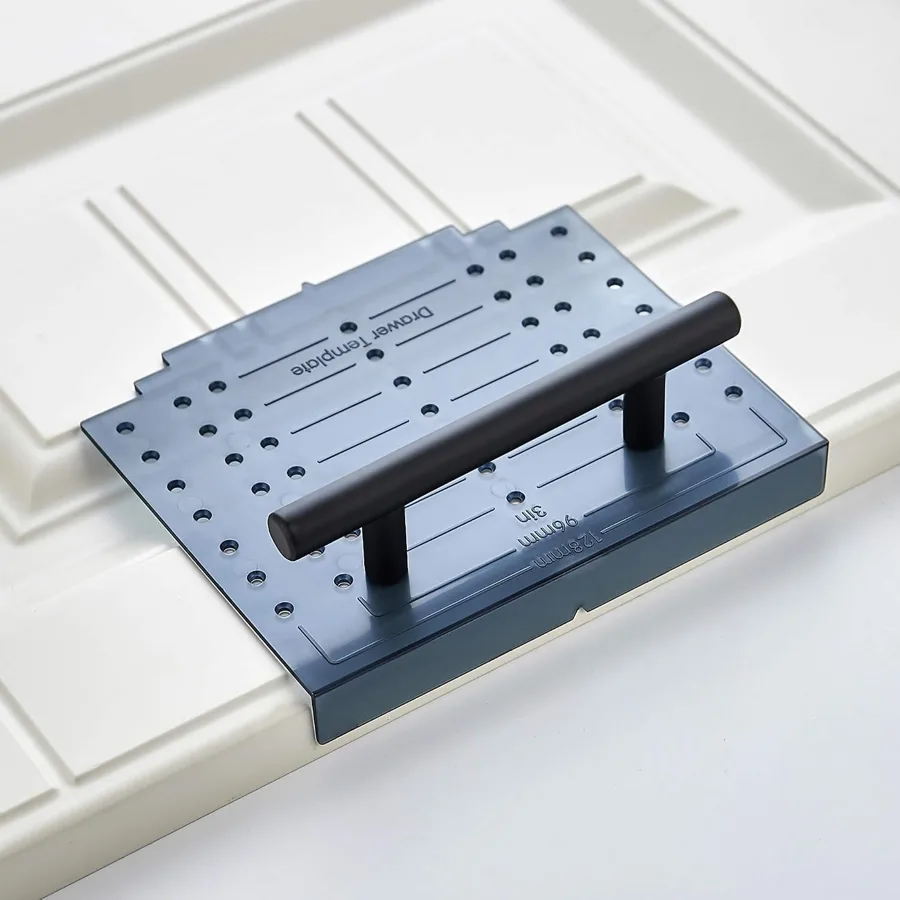
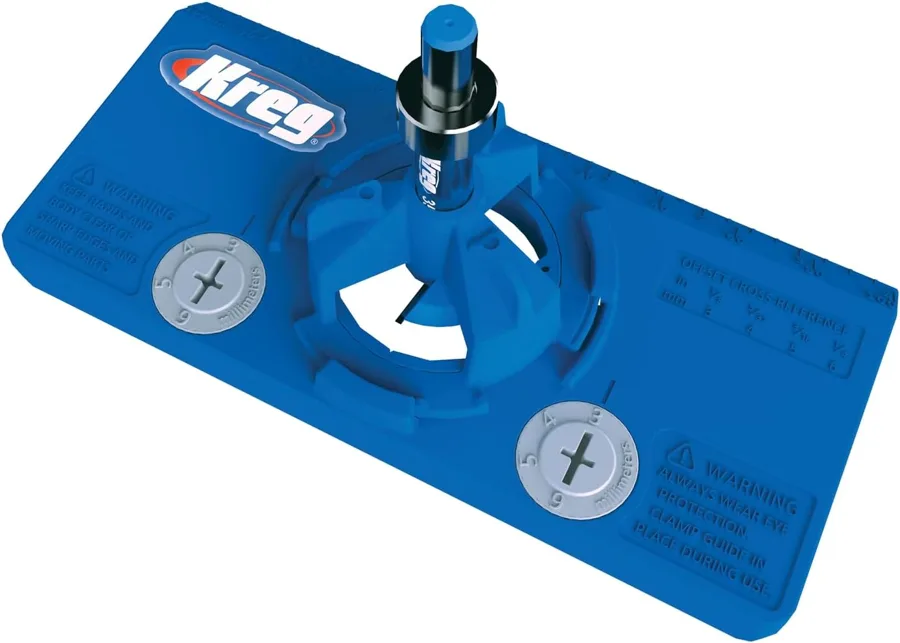
The trouble is that the five models here answer that list in very different ways. One drills hinge cups rather than handle holes, others use plastic frames, and not every one includes a punch. Choosing a cabinet hardware jig means weighing all of that at once, so we compared these five on the same four points.
Here's what we found.
How We Compared Them
This page is a paper comparison of five cabinet hardware jigs, and nobody drilled a hole for it. We set published specs, materials, included parts, size information and real buyer feedback side by side. Where a model had buyer feedback, we weighed what owners praise and what they complain about.
Four criteria carried the weight: Bit Walk Prevention, Spacing Adjustability, Material and Build, and Setup Speed. Each became a plain question for every model. Does it mark the spot before the bit spins, can you set the spacing to your own pull, what is the frame made of, and how fast do you get from box to first door? Every model was scored on the same four criteria.
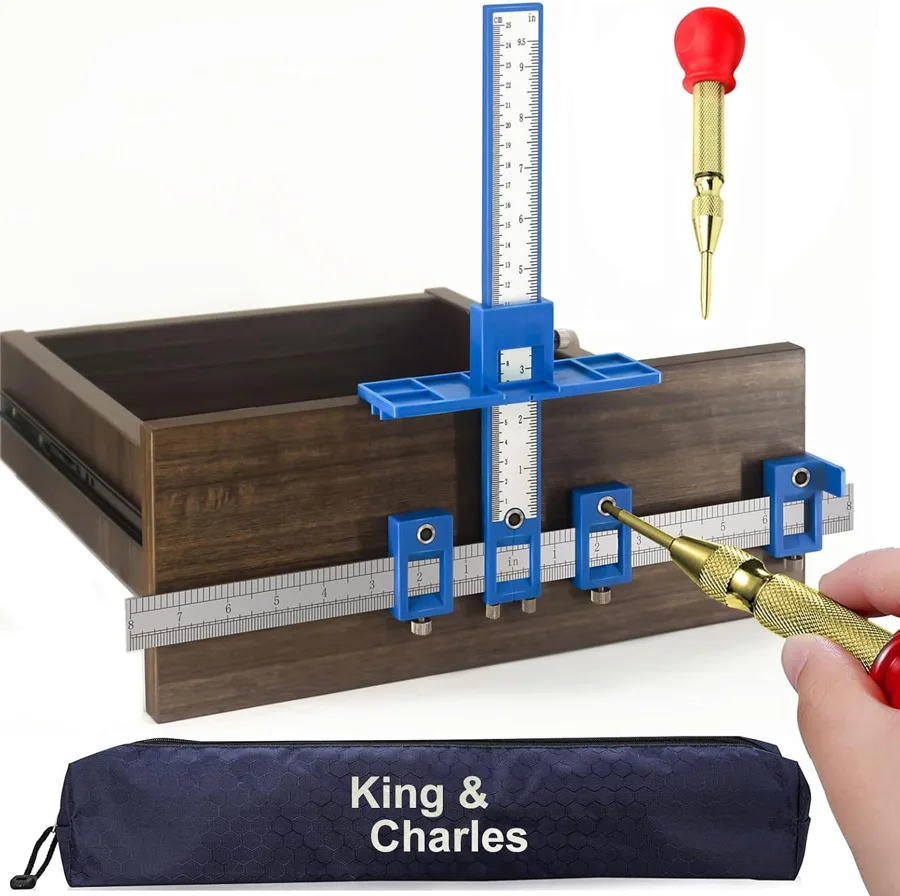
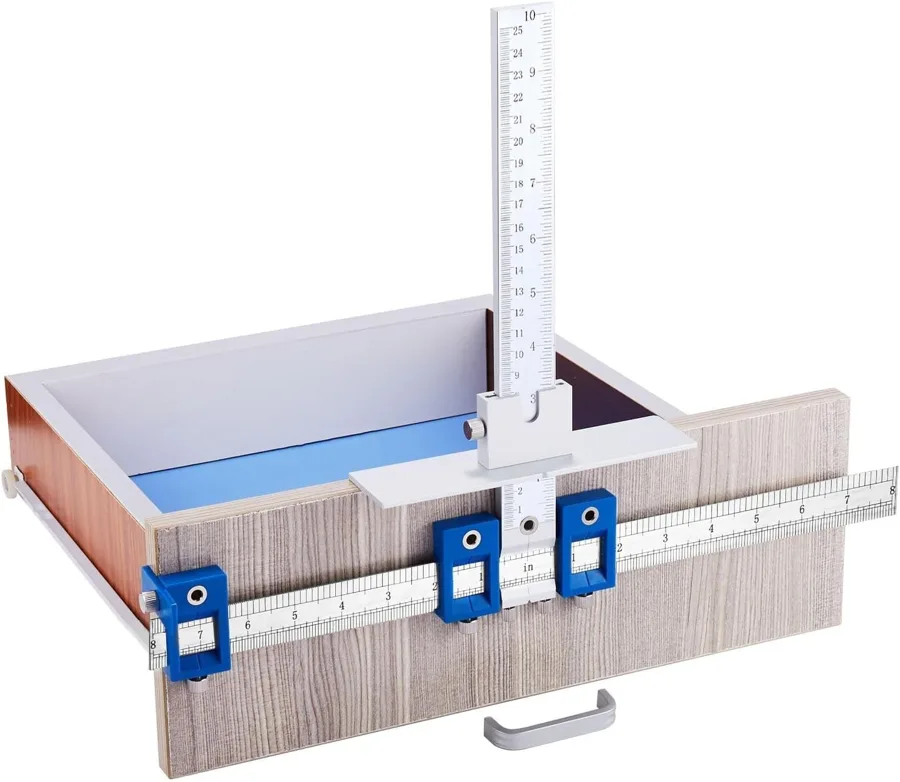
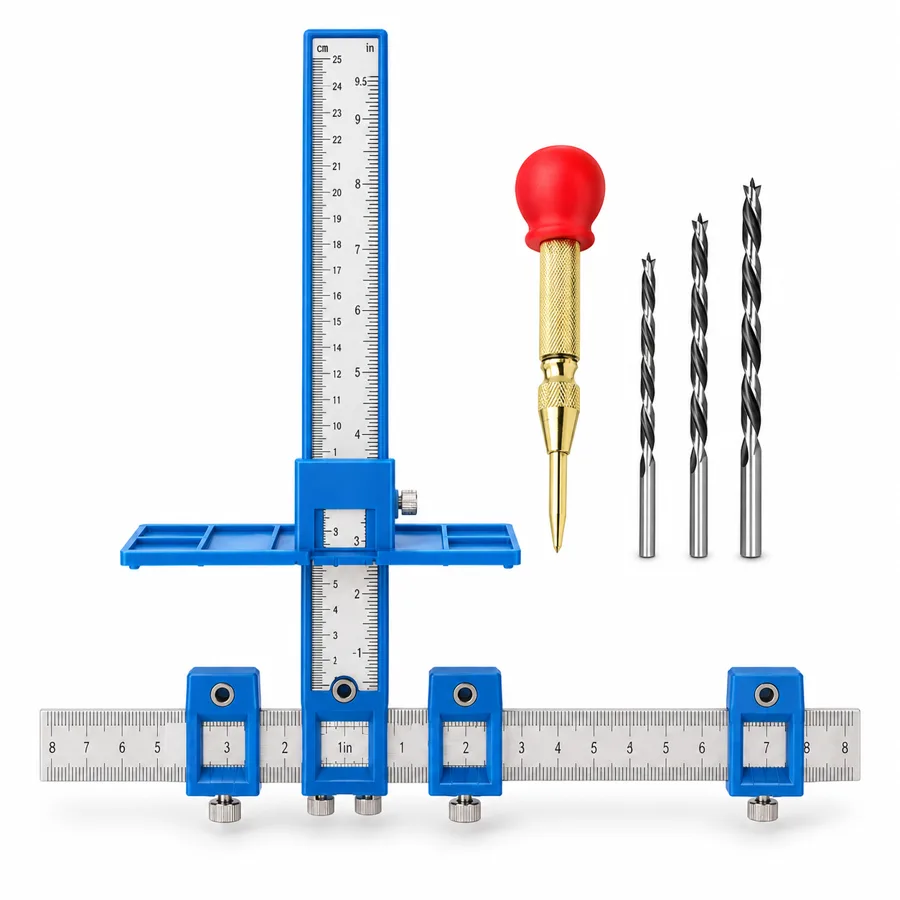
Trueset came first because it combines a spring-loaded center punch, freely adjustable lockable spacing and a steel ruler in one kit. Three sliding guide blocks lock to the ruler with thumbscrews, the dual scale reads in cm and inches, and the punch marks a starter dimple through the guide. That covers bit walk, spacing and setup in one tool.
The long ruler and the vertical depth ruler with cross bar let you set how far holes sit from the edge and repeat it door after door. On the blue version the ruler runs about 420 mm (16.5 in) and the vertical ruler 300 mm (11.8 in). Pick blue or black, with 3 brad-point bits or 4 hex-shank bits in the box, and you can start drilling on arrival.
The honest limitation is that spacing is yours to set, so you take a short measuring step on your pull first. That step is the reason this cabinet hardware jig fits pulls a fixed template cannot. It is made for home use, which suits renovators and furniture projects.
The Results:
Trueset is the #1 choice because it pairs a spring-loaded center punch with freely adjustable, lockable spacing on a steel ruler, so each hole begins exactly where you marked it.
Value
You stop measuring again for every door and taping every pencil mark. Set the guide blocks once, lock the thumbscrews, and move down the row. The makeshift fixes go too: the cardboard template that bends, the pencil mark the bit ignores, the dab of filler that never quite matches.
Doing nothing has a cost you see daily. A plastic template that slips or a bit that skates leaves one pull a hair off, and eye-level hardware shows every miss. Fixing it means dowels, filler, sanding and a repainted door, long after the weekend you meant to spend on the install.
What you get is a locked setup you can trust, door after door. The ruler is steel, and thumbscrews lock each of the three guide blocks to it, so your setting holds until you change it. The spacing stays adjustable for the next pull you buy. Set it once per job and let it carry the whole row.
The Day After the Last Pull Goes On
You open the top drawer and every pull sits level with its neighbor. You stop checking. The jig goes back in a drawer, ready for the vanity you have been eyeing.
It also suits anyone updating a room with new knobs, a hobbyist matching a pair of nightstands, or a landlord refreshing a rental between tenants. Whenever matching holes matter more than speed, a locked setup helps.
Frequently Asked Questions
Yes. Every option includes the jig set and a center punch, plus either 3 brad-point bits, 3, 4 and 5 mm (0.12, 0.16 and 0.20 in), or 4 hex-shank bits. You can start drilling on arrival.
The spacing is freely adjustable rather than fixed, so you set the blocks to your measured center to center, for example 96 mm (3.75 in) or 128 mm (5 in). Hold the pull against the scale, which reads in cm and inches, and lock the blocks in place.
Hold the jig firmly against the door edge while you punch and drill, and use a clamp if that helps you keep it from drifting. Check your first piece on scrap before you move to the real doors.
The thumbscrews lock the guide blocks on the ruler, so you can drill the next door at the same setting. The vertical ruler with its cross bar holds your edge distance the same way.
The center punch makes a starter dimple through the guide first, so the bit begins in a marked spot rather than sliding on glossy paint. The brad-point bits also have a pointed center tip with spurs.
It packs at 45 x 10 x 10 cm (17.7 x 3.9 x 3.9 in) and weighs 400 g (0.88 lb) or 420 g (0.93 lb) depending on option. Measure your pull's center to center, and the distance you want from the door edge.
Pick blue or black, with 3, 4 and 5 mm (0.12, 0.16 and 0.20 in) brad-point bits or 4 hex-shank bits. The blue jig has hollow-out blocks for finding the center line. The black one has black plastic blocks and cross bar with a silver ruler. It marks and drills both knob and handle holes.
They do different jobs. Kreg's KHI-HINGE drills 35 mm (1.4 in) hinge cup holes, while this cabinet hardware jig places handle and knob holes. For pulls, this is the one to choose.
Purchase and Delivery Process
Ordering Trueset is quick. Pick blue or black, then choose brad-point or hex-shank bits.
Then place your order. The jig, center punch and bits you chose come together as one kit.
Where Can I Buy the Trueset?
Getting your own Trueset with a 50% discount is simple. Just follow these steps: