

We Compared the Leading Click Torque Wrenches. Here's Why TrueTwist is #1:
 Written by Emma Collins
Once a plain ratchet is out, the shelf narrows the choice for you: drive size first, then torque range, then how long the wrench is and whether you can read its scale with greasy hands. A 1/4 in drive suits bike bolts, a 3/8 in suits spark plugs, and a 1/2 in drive is what wheel work calls for.
That is where look-alike wrenches part ways. Two models can share a 1/2 in drive and still differ in leverage near the top of the range, in how many steps it takes to set a number, and in what buyers say about the release. The product photos all look alike, and a spec line rarely shows which click torque wrench will ask more of your arm on a stubborn lug nut.
We wanted one honest side-by-side, from a full-length 1/2 in drive down to compact 3/8 in wrenches, built from specs, materials and what buyers wrote after real jobs. Some earned their place, one stood out, and a few left questions behind, so we lined them all up.
Here's what we found.
How We Compared Them
We compared five wrenches on four criteria: Click Feedback, Scale Readability, Build and Finish, and Leverage and Length. This is a paper comparison. Everything comes from published specs, materials, drive sizes, torque ranges, size charts, design details and the real feedback buyers left on each model.
Click Feedback covers how clearly a design tells you to stop, including any missed-click reports. Scale Readability looks at how you set and read your number. Build and Finish weighs the steel, handle and case, and Leverage and Length compares wrench length and torque range against jobs such as lug nuts. Where a model comes in several sizes, we judged the 1/2 in drive, 10-150 ft-lb (13.6-203 Nm) version against its direct rivals.
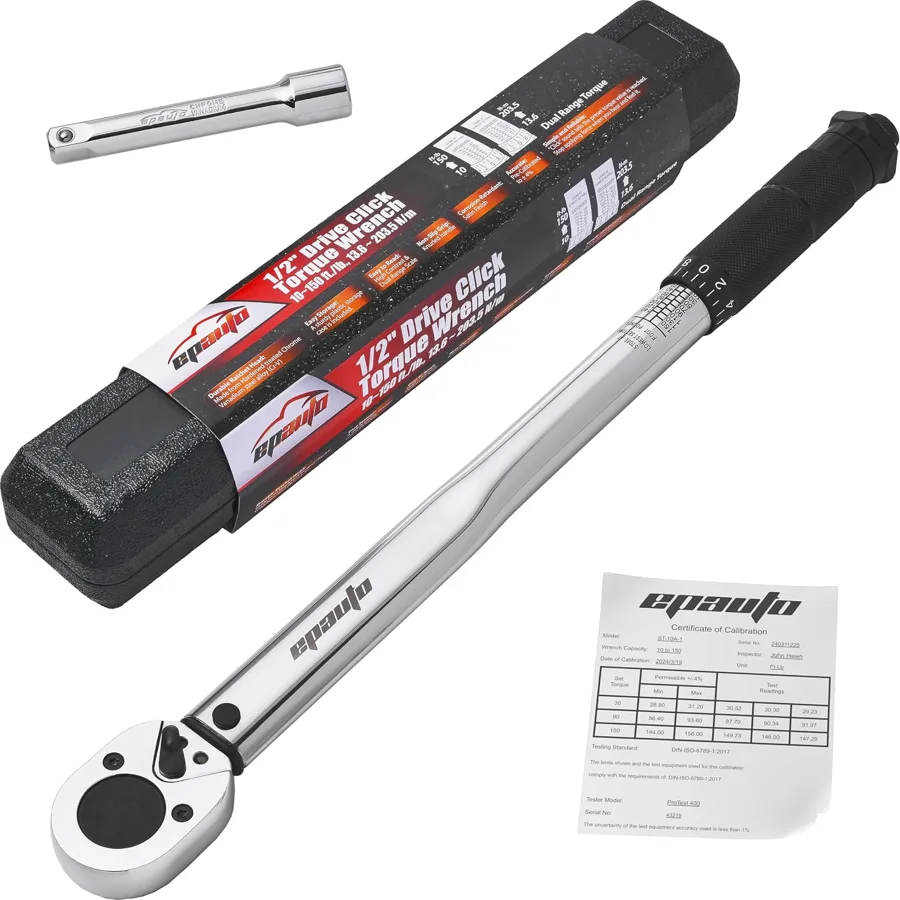
Our top pick won on leverage and fit. Its wrench is 470 mm (18.5 in) long, against 16.25 in (41.3 cm) for the EPAuto that shares its 10-150 ft-lb (13.6-203 Nm) range, and well beyond the compact 3/8 in rivals at about 30 cm (11.8 in) or less. More length means less effort near the top of the range, where lug nuts live.
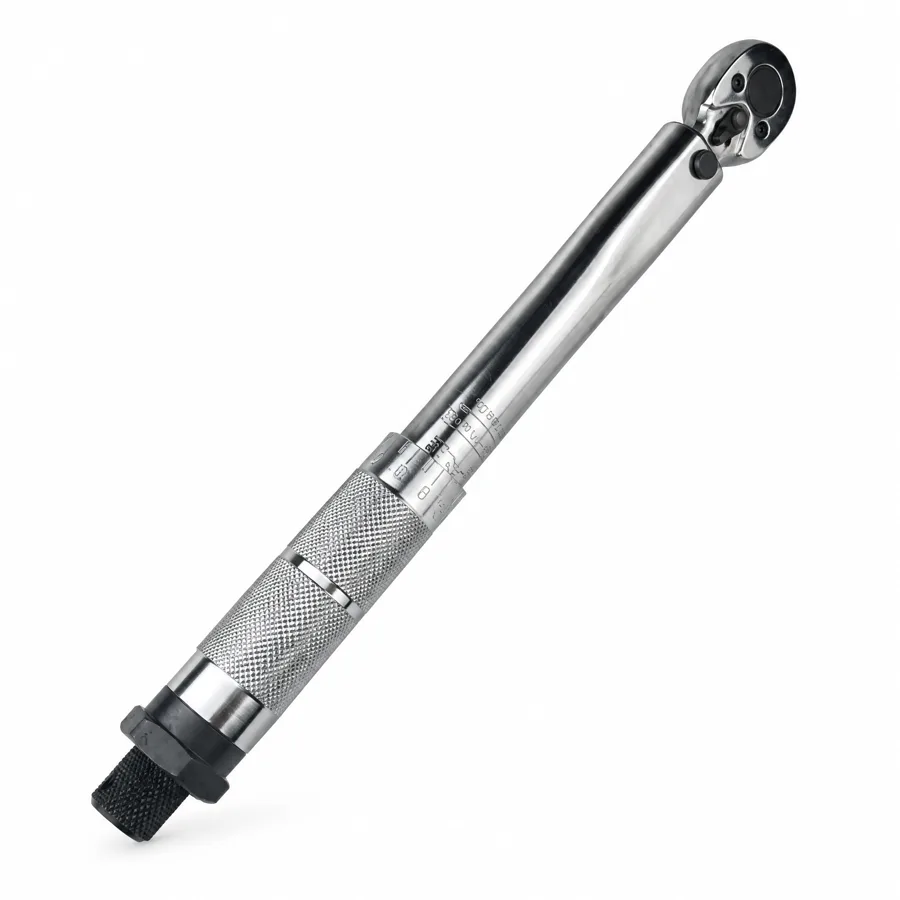
Its secondary strengths add up. The twist-adjust knurled handle puts your number under your hand, the ratchet head takes the 1/2 in drive sockets you own, and the hard black case keeps the wrench protected between jobs. The wider family adds 1/4 in, 3/8 in and long 24.6 in (62 cm) models, so one line runs from small bike bolts to heavy fasteners.
The one honest limit is fit. You match the drive and range to your job, which takes a minute with your vehicle manual. The 10-150 ft-lb wrench comes as a single wrench in its hard black case, while the 5-piece kit with 17 mm (0.67 in) and 19 mm (0.75 in) sockets and an extension is built around the 28-210 Nm (20.7-154.9 ft-lb) wrench. That is a minor step, because your manual's torque spec points straight to the right option.
The Results:
TrueTwist is our top pick because it pairs a longer wrench for more leverage with one-twist number setting and a click that tells you when to stop.
Value
With this wrench you stop tightening by feel and stop second-guessing every wheel. Read the number in your manual, twist it in, pull, stop at the click and move on. No more standing back from a wheel wondering whether it is tight enough.
Doing nothing has a price too. A bargain wrench that never clicks can leave you with a snapped stud, an extractor bit and a weekend lost to a repair you caused. A wheel tightened by feel stays a worry until the next time it comes off.
The knurled metal handle gives a firm grip and the hard black case protects the wrench between jobs. Turn it back to its lowest setting after each use. Set your numbers and let the click do the judging.
After the Last Bolt Clicks
Picture a Saturday in the driveway. The wheels go on, each lug nut gets a number to set and a click to stop at, and the wrench slides back into its black case. You step back from the last lug nut having let the click, not your tired arm, call it.
Who else benefits? Weekend DIYers doing brakes, RV and trailer owners on a spring pre-trip walk-around, and a father teaching a son his first brake job. Motorcyclists can reach for a 1/4 in model, and cyclists have an 11-piece bike set with 2-14 Nm (1.5-10.3 ft-lb) range. It also makes a practical gift for a new car owner.
Frequently Asked Questions
Look up the torque spec in your vehicle manual. If it falls between 10 and 150 ft-lb (13.6 to 203 Nm), the 1/2 in drive model's range covers it, and long 24.6 in (62 cm) versions reach 339 Nm (250 ft-lb) for higher specs. Match your socket to the nut size.
Pull the handle smoothly from its end and stop the moment you feel and hear the first release. Keep the wrench at its lowest setting between jobs, and try it on a known bolt before a critical one. Those habits keep a click-type wrench behaving the way it should.
Turn it back to its lowest setting, which is 10 ft-lb (13.6 Nm) on the 1/2 in model, and put it in its hard black case. That keeps the spring from sitting under tension for months.
It is a click-type wrench, so the release signals you to stop. Pull smoothly from the end of the handle, stop at the first release, and try it on a known bolt first.
The 1/2 in wrench is 470 mm (18.5 in) long, which gives you leverage near the top of its range. For tighter spots, a short 3/8 in version is 280 mm (11 in) and covers 19-110 Nm (14.0-81.1 ft-lb).
Yes, there are smaller models for that. The 1/4 in drive covers 5-25 Nm (3.7-18.4 ft-lb), and an 11-piece bike set covers 2-14 Nm (1.5-10.3 ft-lb) with nine socket bits and an extension.
The 10-150 ft-lb (13.6-203 Nm) wrench comes as a single wrench in its hard black case. The 5-piece kit with 17 mm (0.67 in) and 19 mm (0.75 in) sockets and an extension is built around the 28-210 Nm (20.7-154.9 ft-lb) wrench.
Measure two things: the torque spec in your manual, and the drive size of the sockets you own, 1/4, 3/8 or 1/2 in. Also check the shelf or toolbox space, since cases run from 310 mm (12.2 in) for 1/4 in models to 495 mm (19.5 in) for the 1/2 in wrench.
Purchase and Delivery Process
Open the store page for TrueTwist and choose your drive and range from the Model and Kit menu. Check the torque range against the spec in your vehicle manual, and the drive against the sockets you own.
Then add it to your cart. The store page shows the current offer, the options available and the delivery details, so you can review everything before you order.
Once it arrives, set your number, pull until it clicks, and return the wrench to its hard black case.
Where Can I Buy the TrueTwist?
Getting your own TrueTwist with a 50% discount is simple. Just follow these steps: