

We Compared the Leading Hot Wire Anemometers. Here's Why DraftLens is #1:
 Written by Emma Collins
A hot wire anemometer works on a simple idea: a heated element cools as air moves past it, and the meter turns that cooling into a speed. Because nothing has to spin, faint airflow still registers. That is why the principle suits bathroom fans, small registers and weak supply outlets.
The catch is that look-alike meters share many of the same headline numbers, so a spec sheet alone does not separate them. What does is probe design, readout and build. Look for a probe that reaches deep and bends into angled outlets, an area setting that does the multiplying, and a screen you can read in a dim attic.
Then add the practical questions: how the meter is powered, how easy the first setup feels, and what real buyers say after using it. Those details decide whether a meter stays in your bag or ends up in a drawer. So we set five side by side, starting with how we compared them.
Here's what we found.
How We Compared Them
We compared five models on four criteria: Low Airflow Sensitivity, Probe Reach, Easy CFM Readout, and Build and Portability. This is a paper comparison. We set each model's specs, materials, size and weight figures, probe design, display features and extras side by side.
For the four models we do not sell, we also went through real buyer feedback and noted what owners praise and what they repeat as complaints. Each criterion got a percentage based on how strongly the facts and buyer comments support it. A longer probe or a finer resolution earned credit only where it helps at a real vent or duct.
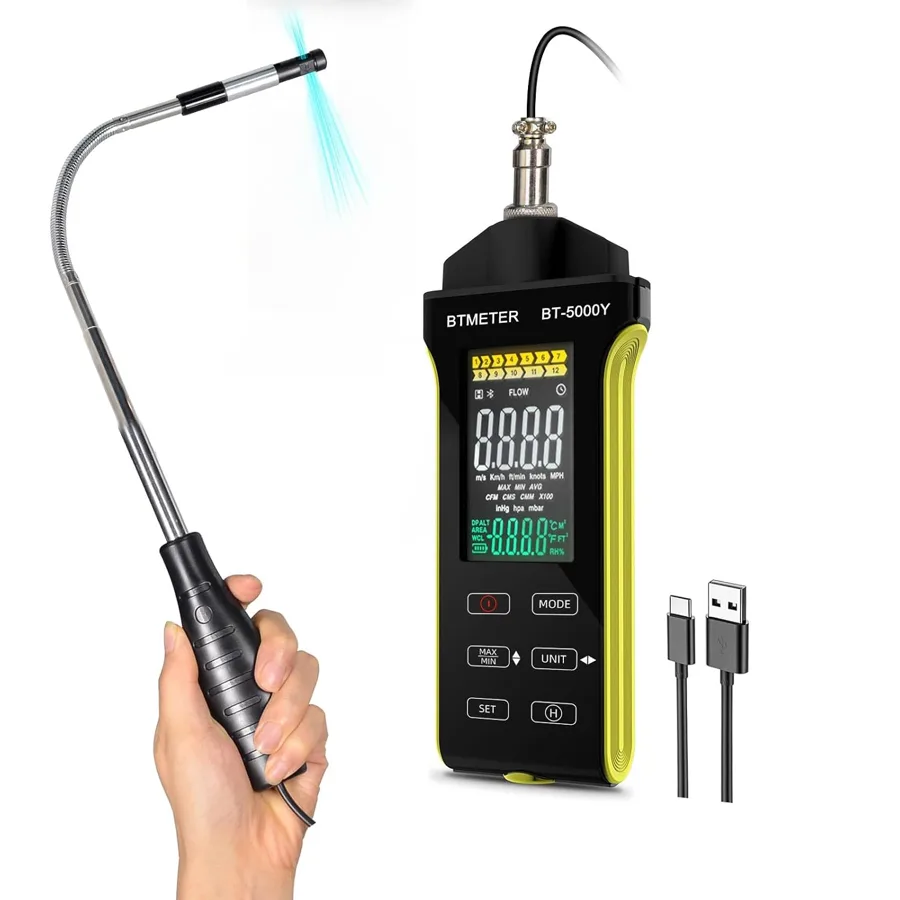
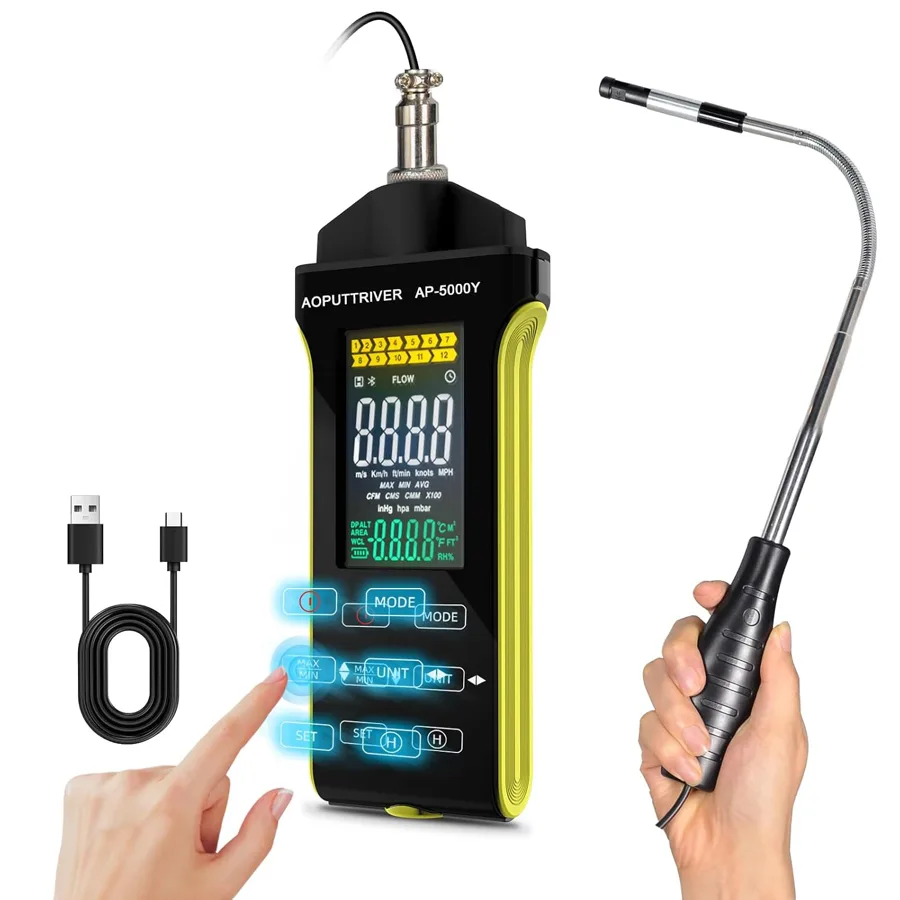
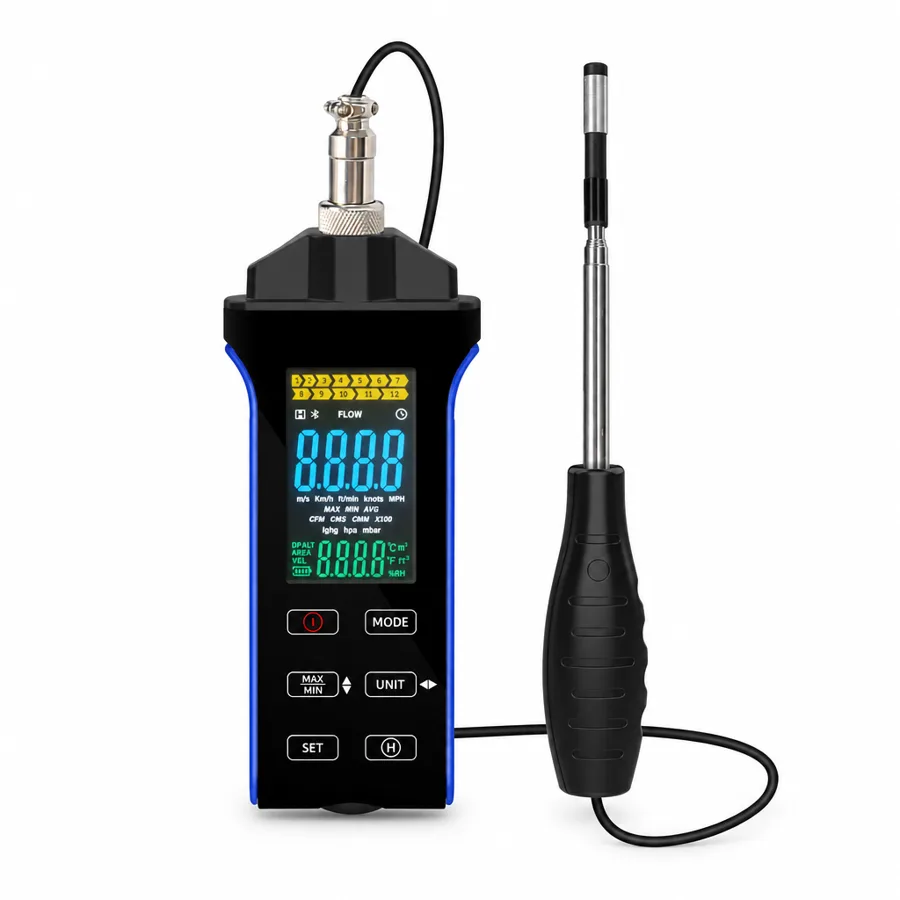
On paper, our top pick wins on reach and readout. DraftLens has a bendable probe that extends up to 890 mm (35.0 in) on a 1040 mm (40.9 in) cable, so you angle the sensor into deep ducts and ceiling outlets from where you stand. The area setting turns speed into CFM, CMS or CMM on the screen.
Secondary strengths steady a moving number. Data hold and MAX, MIN and AVG readings let you judge a wavering figure, and the color backlit screen reads in dim attics. Units switch to the ones you already know, and the meter weighs 125 g (4.41 oz), light enough for a tool bag.
One honest limitation: you must measure the opening and enter its area before the meter can show air volume. It takes a tape measure and a minute, and any meter that calculates CFM needs the same step. That is why we count it as minor.
The Results:
DraftLens is the top pick because it combines faint airflow sensing, a bendable extendable probe and an on-screen air volume readout in one light handheld meter.
Value
With this meter you stop guessing at weak vents. No more crouching behind a short probe, no phone calculator balanced on a ladder, no second person holding things in place. You extend the probe, set the area once and read the number.
Doing nothing has a cost too. A vane meter that reads zero sends you back for a second visit, a hand worked figure with a swapped unit sends you chasing the wrong problem, and a customer who doubts your numbers is hard to win back.
The design is easy to trust at a glance. A black ribbed grip handle with a button on the probe sits well in the hand, the probe cable plugs into a screw-type metal connector on top of the meter, and auto power off saves the battery when idle. Like any heated-wire sensor, it rewards gentle handling, and that small habit keeps your readings steady.
After the Job, the Numbers Are in Hand
You finish at the register, press H, step back and read the number, even in dim attic light. The customer sees the airflow on the color screen, and you leave with figures to show instead of a shrug.
Others benefit too: home energy auditors checking a weak bathroom fan, homeowners tracking down a hot upstairs bedroom, apprentices learning duct work, and crews in construction or industry. It is built for HVAC, duct and ventilation checks, and outdoor use is shown too.
Frequently Asked Questions
Press SET, enter the area of the opening, and the meter works out air volume for you. Measure the opening carefully first, then read it in CFM, CMS or CMM. The first time takes a moment to learn, and after that it is one step.
The bendable probe extends up to 890 mm (35.0 in) and connects by a 1040 mm (40.9 in) cable. That is enough to angle into most ceiling vents and ducts from where you stand.
Wind speed accuracy is 5% ±1 digit, with a resolution of 0.1 (1 for ft/min). That suits residential and light commercial vent checks and showing a customer real numbers. Professional in-duct meters are built for daily balancing, so choose one if regulated work is your job.
Handle the tip gently and keep it clean. Like any heated-wire sensor, it rewards a light touch, so avoid knocking it against duct edges or grilles.
It runs on a rechargeable 600 mAh lithium battery. Auto power off shuts the meter down when idle, so there are no disposable batteries to stock.
Yes, it shows air temperature from 0 to 45°C (32 to 113°F), with a resolution of 0.1. That lets you read temperature and airflow at the same vent.
Speed shows in m/s, km/h, ft/min, knots or mph, air flow in CFM, CMS or CMM, and temperature in °C or °F. The UNIT key switches them, so you can work in the units you already know.
Air in a duct is rarely steady, so a moving number is normal. Press H to hold a value, or use MAX, MIN and AVG to see the spread. Checking a few spots across the opening gives a fairer picture.
Purchase and Delivery Process
Use the button to open the DraftLens page, review the product details, then order.
Once you confirm, you are set to measure faint airflow, reach deep ducts and read air volume on the screen.
Where Can I Buy the DraftLens?
Getting your own DraftLens with a 50% discount is simple. Just follow these steps: