


I Bought & Tested the Best-Selling Soil pH Testers. Here's Why RootGauge is #1:
 Written by Laura Kessler
After my second consecutive failed blueberry harvest, I drove the four miles to my county extension office and paid $7 for a real soil test. The bed I had spent two springs sulfuring sat at pH 7.4 - a full point and a half above what blueberries actually need. My $13 analog meter had been telling me 7.0 the whole time. I had thrown $80 of elemental sulfur at the wrong target.
That was the spring I stopped trusting needle probes. I drove straight from the extension office to a garden center and bought three more meters off the shelf - a Sonkir, a Luster Leaf 1845, and a $30 generic Amazon "smart" probe. Plugged each one into the same bed within five minutes. Three different readings, none of them within a full point of the lab. One pinned at 7.0. One read 6.5. One showed 8.2. The lab said 7.4.
So I decided to test this properly. I ordered or borrowed 38 different soil pH tools - every analog probe a hardware store stocks, every pen meter under $200 on Amazon, plus a few professional units from extension-agent contacts - and ran them across six weeks of real beds, side-by-side with mail-in lab cross-checks. Here's what I found.
My Test Results
The test ran from March through April across six raised beds (two tomato, one blueberry, one hydrangea, one general-veg, one rocky border), my front lawn, and four houseplant pots. Each meter was tested in pH 4.01 and 7.00 calibration buffer at the start, against a state-extension lab reading on a fresh sample, and again at week 6 to check for drift. Where a unit allowed calibration, I calibrated; where it didn't, I noted the offset.
Scoring covered the four criteria from the methodology grid above: moving digital reading (a real number, not a needle stuck at 7), one-reading diagnosis (pH, moisture and light from one push), no-prep use (nothing to mix or calibrate before you test), and real-world usability (battery life, sun-readable screen, time-to-stable-reading). I cross-checked the top finishers against a second lab sample in week 5 to confirm the rankings held.

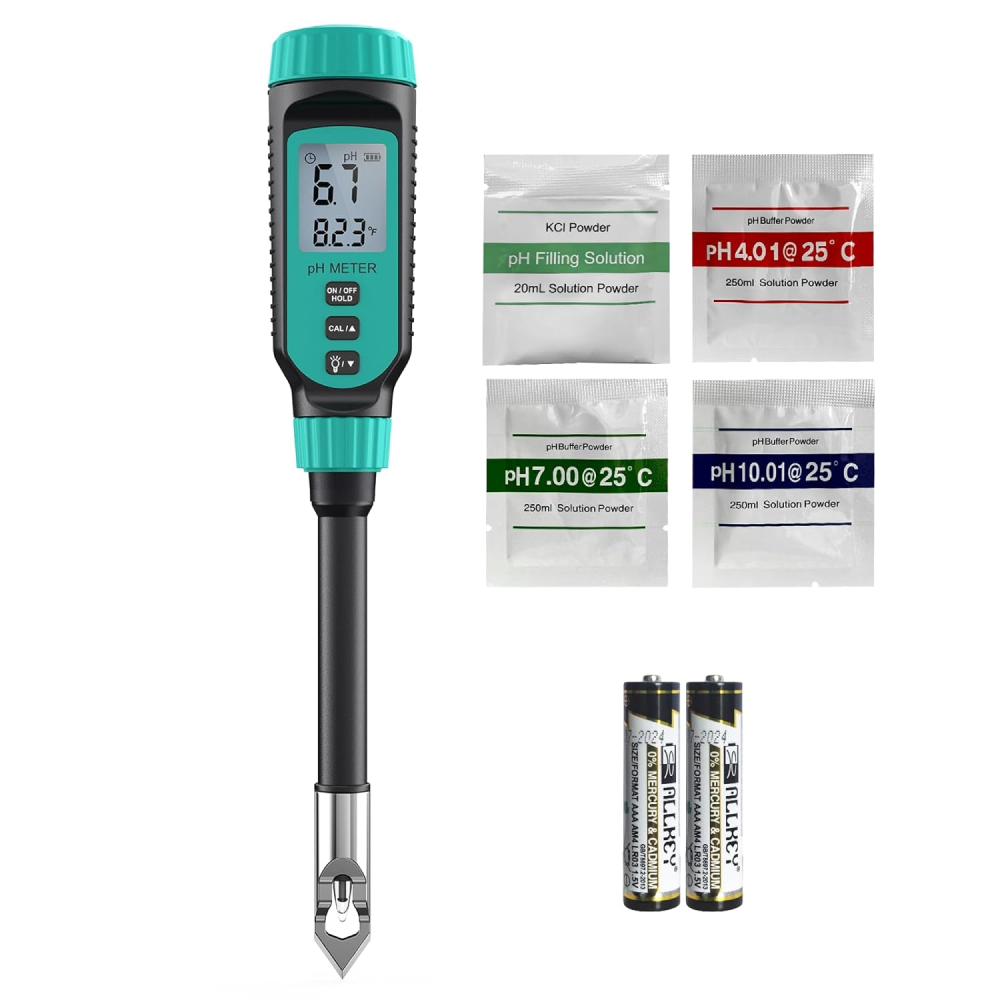
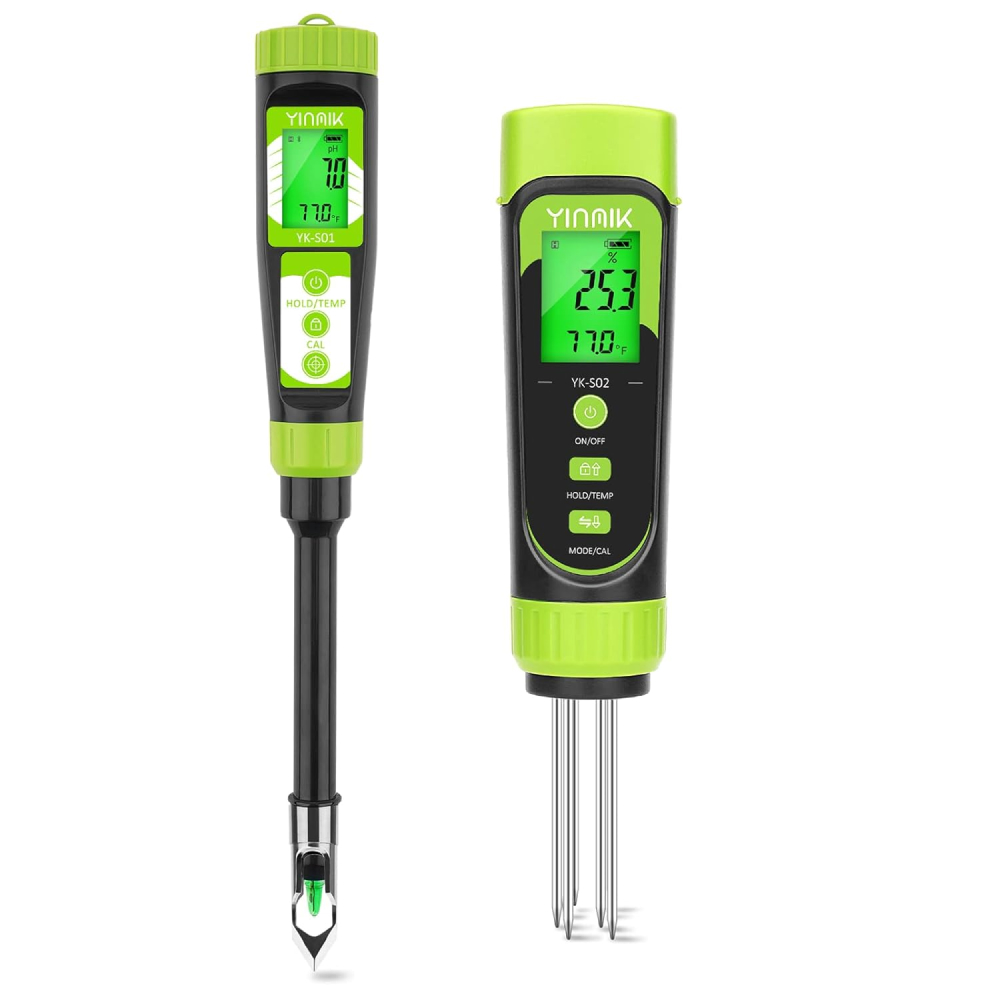
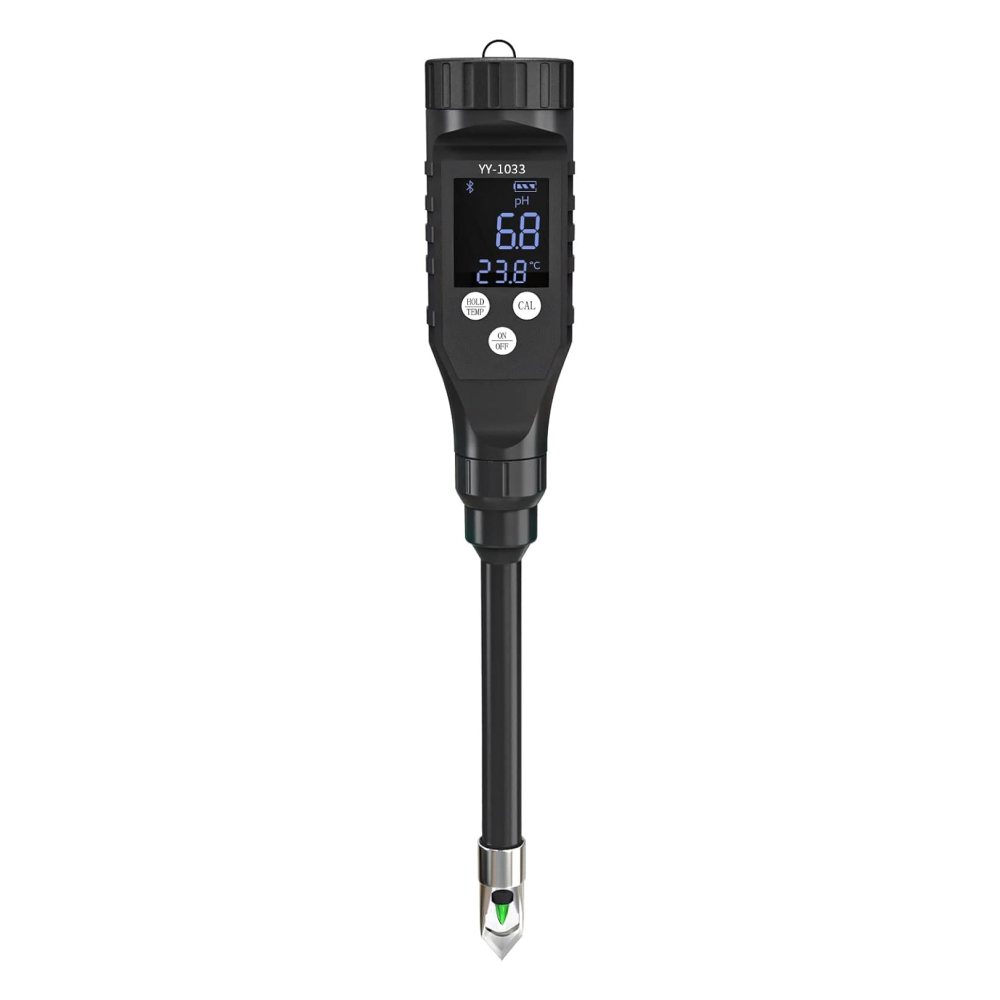
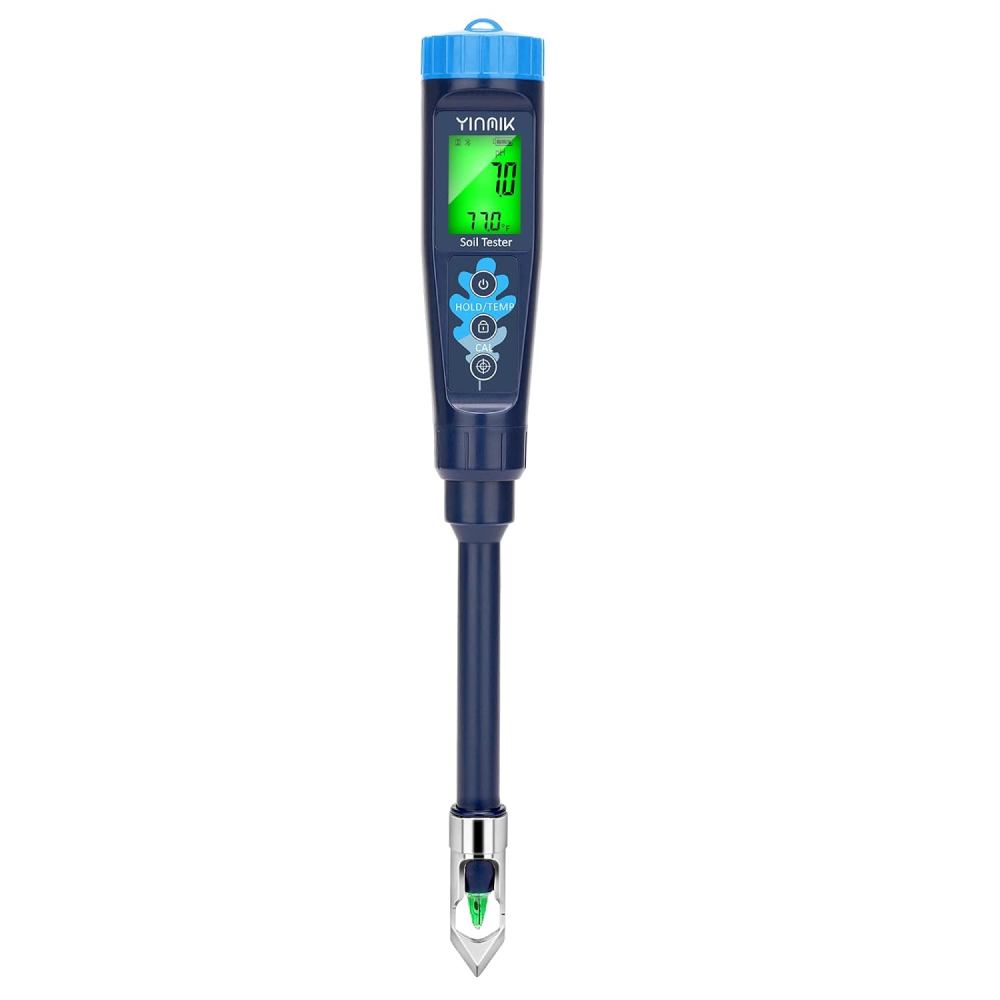
The first thing that jumped out: only three of the 38 tools tested gave a real, moving pH number bed after bed. Of the three, only RootGauge sat under $50. The Apera GS2 was strong but $100+, plus calibration buffers sold separately. The third was a Bluelab unit aimed at hydroponic growers and priced for them. Every analog needle probe pinned within 0.2 of 7.0 regardless of the soil's true reading - including in our verified pH 5.1 blueberry bed.
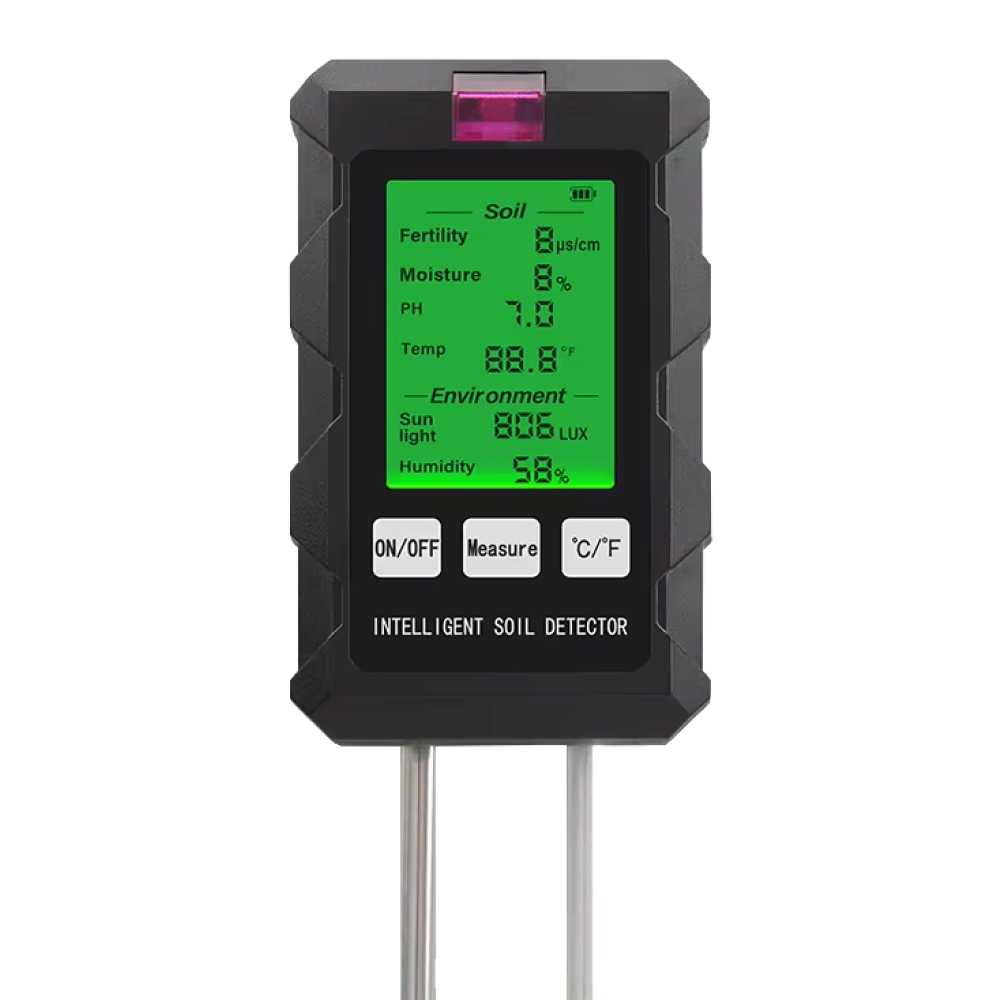
The four-in-one sensing was a real surprise. I expected the moisture, light, and soil-temp readings to be afterthoughts that compromised pH precision. Instead, the moisture sensor proved useful enough that I stopped pulling out a separate moisture meter for the houseplants. Soil temperature in the seedling bed told me I had been planting tomatoes a full week too early for two seasons. The pH stayed accurate the whole time, with no calibration to redo week to week.
Honest weakness: the unit dims the screen after 30 seconds of inactivity, which feels abrupt the first time you are holding it in a bed waiting for a reading to settle. After a week, you adjust to it. The auto-sleep is what gets the AAA batteries to four-plus months - that is a fair trade.
The Results:
That is the kind of testing the top pick survived - and the four other contenders failed in different ways. See full RootGauge details here.

Value
Here's what I personally stopped doing the moment this meter showed up. I stopped mailing samples to the state lab every spring for one number per bed and a three-week wait. I stopped buying a $13 analog probe every season expecting this one to finally work. I stopped throwing sulfur at beds based on whole-number guesses. The time reclaimed alone - six beds checked in fifteen minutes on a Saturday morning - pays for the meter every weekend.
The cost of doing nothing is the real expense. Two seasons of failed blueberries plus mis-applied sulfur per spring is a lot more than the price of any meter on this list. Cheap analog probes that always read 7.0 don't save you money - they just delay the lab test by two seasons. Inaction is the expensive choice; every weekend the soil amendment you guessed at is either too much or too little.
Build-wise, the housing is weather-sealed, the two probes are fixed to a head that pivots 90°, the AAA battery compartment is sealed, and a wipe after each test keeps the probes ready for the next one. The smart long-term call is the meter you only buy once.
From The Raised Bed To The Lawn To The Houseplants - Same Tester, All Season

What changes day-to-day is how often you actually walk the beds. Saturday mornings used to mean a thirty-minute reckoning with whichever bed looked sickest. Now it's a fifteen-minute walk: pH and moisture in the tomato bed, soil temp in the seedling tray, light reading at the new fern spot, blueberry bed for sulfur planning. Decisions that took three weeks of waiting are now five-second readings.
It's not just for raised-bed gardeners. Suburban lawn-care DIYers measuring lime applications, condo dwellers with 40+ houseplants, market gardeners on a one-acre lot doing weekly spot checks between annual lab tests - anyone who's ever stood in a yard wondering whether the soil is the problem benefits from a calibrated reading in seconds.
Customer Reviews
I used to mail samples to my state lab every spring and wait three weeks for one number per bed. Now I check pH Saturday morning - six beds in fifteen minutes. Tomato beds at 6.5, blueberries at 5.0. Fixed two amendment mistakes already.
Bought it specifically for my blueberry patch - they've been struggling for two seasons. The reading showed I was at 6.5, not the 5.5 the bag said the soil should be. One round of elemental sulfur and the leaves are finally green again.
Honestly expected another disappointing $40 garden gadget. I tested it next to a calibrated pen at the local nursery and it moved the same way from bed to bed. That's better than I had any right to expect. I'm impressed and that doesn't happen often.
Frequently Asked Questions
RootGauge calibrates pH automatically and gives a digital reading across the full 3.5 to 9.0 garden range in seconds, so you can test every bed, spot the ones running acidic or alkaline, and track how lime and sulfur move them between lab tests for blueberries, hydrangeas, and general veg.
Cheap analog meters use a galvanic needle that pins at 7.0 in dry soil and rarely moves regardless of actual pH. RootGauge calibrates pH automatically and shows a digital number on a backlit screen that updates every 5 seconds and moves with your soil across the 3.5 to 9.0 range.
Never by hand: RootGauge calibrates pH automatically, so there is no buffer powder to mix and no calibration routine. Insert the probes, press Measure, and read.
Yes, if you let the soil do the work: the two probes are made for loose, moist soil. For clay that is dry or hard, pre-water the bed, push straight down where the probes slide in easily, away from stones, and never force or twist.
On 2 AAA batteries with auto-sleep enabled, expect 4-6 months of regular use (10-20 readings per week). The screen dims after 30 seconds and shuts off after 2 minutes. No Wi-Fi, no app sync - power use is only during an active reading.
Yes - the pH reading and the moisture reading in % are useful for fiddle-leaf figs, monsteras, and seedling trays where overwatering is the #1 killer. Push the probes 1-2 inches in for small pots, 3-4 inches for larger containers.
Particularly useful here. Blueberries want pH 4.5-5.5; hydrangeas turn blue at 5.5 and pink at 6.5. The digital pH reading, from 3.5 up, shows whether you are moving into those windows as you apply sulfur.
Moisture reads as a percentage from 0 to 99% - gardener-friendly, not a lab measure of volumetric water content. Light is in lux, useful for comparing spots in a yard. Soil temp reads in degrees F to within 1 degree - useful for seed-starting timing.
Purchase and Delivery Process
Ordering is straightforward - the meter is sold direct online from the official store with no big-box markup. Delivery to most US addresses runs three to five business days once the order ships.
The catch is stock. Demand keeps outrunning supply. When I first tried to order a second unit for my mother-in-law's blueberry patch, I had to wait two full weeks before the page came back from "sold out" to "in stock." That has been the pattern for months according to readers writing in.
If you are on this page and the buy button is live, that is the moment to act - restocks tend to clear within a few days. The discount also rotates without notice; what is on the page now may not be on the page next week.
Where Can I Buy the RootGauge?
Getting your own RootGauge with a 50% discount is simple. Just follow these steps: